Wednesday, 25 April 2007

Entry 7 - The Darkest of Days – Carthage Jail, Illinois. 13th April, 2007.

Just before arriving at Nauvoo we stopped at Carthage Jail for a tour there. I did not like Carthage, the township, very much at all. I imagine it has not grown a whole lot since the 1840’s, and certainly has not prospered greatly either. It did not have a nice feel about it at all. But I did really enjoy the tour of the jail.

Dallan & Wayne next to the memorial to Joseph and Hyram, at Carthage Jail.

There were a couple of things I never realised about the jail. The first is that it was also a residence for a family at the time. The family lived in most of the house, and there were two holding areas, which contained bars and locks. At the time of the Prophets death they were actually being held in the bedroom of the jailor, and it was quite comfortable with a large double bed, a desk and fireplace. There was also extra bedding supplied for the rest of the detainee’s.

One of the holding cells within the jail. The men were moved from this downstairs cell to an upstairs bedroom because the jailor thought it would be safer, and more comfortable, for them.

The second thing was that in comparison to Liberty Jail, their stay here was much more comfortable and relaxed. Apart from the ultimate outcome of their stay here, they didn’t suffer too much from cold or deprivation. In fact, the jailor felt that the cell that they were originally in was too hot and crowded for them and thus moved them to the upstairs bedroom where it would be much more comfortable and airy. However, their struggles were not so much in the physical sense, but more in the psychological sense. The mobs were surrounding the jail for some time and there were many rumours about what was going to happen. So even though they were physically comfortable, psychologically they must have been on the edge.


The second cell upstairs. It was under this straw mattress that Willard Richards dragged seriously injured John Taylor to, when there was a lull in the attack. This saved his life.


A view into the room where the Prophet was martyred.


The gunshot hole in the door that killed Hyrum Smith instantly.


The window through which Joseph fell when he was shot.


The view through the window


An outside view of the window that Joseph fell through.


Tuesday, 24 April 2007

Entry 6 - A Village So Fair – Kirtland, Ohio. 11th – 12th April, 2007.

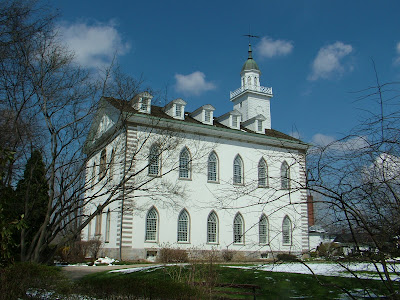
Kirtland Temple

Our introduction to Kirtland was one that I will remember. As we drove down and then up the hill the Temple grew directly in front as we got closer, until it filled our whole vision. It was lovely.

We decided to do the Temple tour first, since we were right there and it would cover the segment by the ‘Community of Christ’. After viewing a short film we were guided into the Temple. Unfortunately, we were not able to take pictures inside, so my memory will have to serve me. I will try to describe it as best I can.

This is the closest I got to getting an interior picture.

When entering the front door the first thing that hit me was the two beautiful staircases on either side of the entrance. The handrails were original, and each step to each level represented one year in the life of the Saviour. The building was light and airy and appeared not to have any electric lighting. There are so many windows around the building that I would doubt they would ever need lighting during the day.

We were taken to the top floor first, which was divided into four different rooms. The room on the far east side was the Prophet’s room and it was in here that he received D&C 137. In this vision he received an assurance that his brother Alvin would be blessed with an inheritance in the Lord’s kingdom, even though he had not received baptism. Again, there were enough windows in this room to make it pleasantly light, airy and even warm with sunshine.


An example of the different stages of construction for the seating pulpits in the Kirtland Temple. I included this so that you can see what they would have looked like. At completion they were painted white with gold edging. Each seat was marked with the priesthood office of the person sitting there.


This is the window that shines into the lower level of the Kirtland Temple. Just the other side of this window was where the Saviour, Moses, Elias and Elijah visited Joseph and Oliver.

The first and second floors of the Temple were very similar in design, with Aaronic Priesthood seating raised at one end and Melchizedek Priesthood seating raised at the other. The rest of the room contains general seating. From the ceiling, during Joseph’s time, there were pullies that could lower sheets to divide the room off into sections. This was to accommodate smaller groups for discussion and lessons. It was on the first level that the Father and the Son appeared to Joseph and Oliver, while the Temple Veil was lowered. They were also visited by Elias, Moses and Elijah.

The one practical observation I made was that each pew within the congregation was closed off with a door at the end in order to keep the warmth in. Very practical in a place where it would have been extremely cold in the winter, and at a time where heating was not readily available.


A view of Old Kirtland. Restored and reconstructed by the Church.

I loved Kirtland for its quaintness. It would have been lovely to see it in full bloom, and better still in the autumn. I can only imagine the colours it would produce. It had the feel of old England in places. We stayed overnight in Chardon, and the drive was magic. The snow was thick and fresh on the ground around us, and the houses took on a quaint appearance with their icicles hanging from the rooves.

Old Kirtland, run by the Church, was most interesting. Many of the houses were accurately reconstructed from the era and each had a special story. My favourite would have been the Whitney Store. Not only for its beautiful presentation of products, but for the fact that Joseph and Emma had spent some time living there and many sections of the Doctrine and Covenants were received there.

The Whitmer Store. We saw a replica of this building in Provo at the Church's movie studio backlot. It was much better here with all its goods and shattles.


We were able to attend the School of the Prophets which was located above the Whitney Store.

Wayne tries his hand at mixing ash to make soap the pioneer way.

On the way out to the John Johnson Farm we stopped off to look at the quarrie where the saints dug the rock for the Kirtland Temple. It was covered in snow and was freezing, but well worth the stop. You can still see the chisel marks where they cut the rock. It is in the middle of a river and must have been cold and wet to work there. Joseph Smith was appointed the quarrie manager for a time.

Wayne inspects the quarrie where the rock was cut for the Kirtland Temple.

The other highlight for us here was the John Johnson home. This was where the prophet and Sidney Rigdon were tarred and feathered and the school of the Prophets was held for some time. The greatest thing that happened here was when Joseph and Sidney had a vision of the saviour. As the vision progressed each would ask the other, “What do you see?” Almost with the idea of making sure they were both seeing the same thing.

The John Johnson Farm. Located about 45 minutes southeast of Kirtland. It is here that Joseph and Emma stayed for some time. This was also the place that Joseph and Sidney were dragged from their beds and tarred and feathered by a mob. One of Joseph and Emma's twin babies died a few days later as a result of exposure to the cold on that same night.

One of the things that I hoped to do while in the east is visit a place were the Amish people lived. There are many places that they live throughout Ohio, Pennsylvania, Indianna and even Missouri and Iowa. On our drive out to the John Johnson Farm we drove through a place called Middlefield. They had a large cheese making factory there and a small Amish community. The Amish people do not like you to take photo's of themselves, but are happy for you to photograph their homes, buggies and farms. You can recognise an Amish farm by the grey and blue washing hanging on their lines (no one in the US hangs washing out, they wouldn't even know what a clothes line was. They dry their clothes in electric dryers) and by the lack of power lines, TV antenna's and cars around their houses.We stopped in at an Amish farm that had a little shop in the back and I bought a quilt sampler there. We chatted with the Amish lady there and her 9 year old daughter. They were dressed in their traditional clothes, with the starched white caps and simple grey dresses. It was a pleasant experience. I managed to catch a picture of two horse drawn Amish buggies passing each other on the main road into town. They are a simple people who don't rely on modern conveniences such as electricity, cars or telephones. It seems that both modern culture and Amish culture function well together in these areas.

Two Amish buggies pass each other on the main road into Middlefield township, Ohio.

Entry 5 - Rolling Waters – Palmyra Temple & Niagara Falls, New York. 10th April, 2007.

Palmyra Temple
On our way out this morning we visited the Palmyra Temple. Because we were visiting this area on a Sunday and Monday, we were unable to do a session in the Temple. We were also concerned that the gates had been shut and locked the day before, and that we would not be able to even walk around the grounds. However, this morning there were some groundsmen doing some work and they gave us permission to drive up and wander around the grounds. That was a nice turnout. From the outside we could see that most of the windows were stained glass with what appeared to be depictions of the Sacred Grove. I would have loved to see them from the inside. Oh well, that just means I will have to come back here again some day. There were also some curious external markings on the walls. Just over the entrance there appeared to be three carvings of the moon at three different phases. I know that the moon represents one of the degrees of glory, but I was curious to know what the three different phases stood for. The head groundsman said that there were many interesting symbols all around the temple, such as the two toned pavers. However, he couldn’t enlighten us on their meaning.

The rolling waters of Niagara Falls

From here we bid farewell to Palmyra and headed west to the famous Niagara Falls. The plan was to stay overnight there and view them the next morning. However, we arrived there with enough light to drive across the boarder into Canada and view them from the best side. Parking was an issue, so we were limited to the time we had. I was impressed with the fall’s, particularly with the huge blocks of ice that lay at the base of them, and the water that was pounding them. But I have to admit that I imagined them to be a lot higher and wider. If I can draw an analogy with our expedition then the image of ‘rolling waters’ in D&C 121:33 came to mind as I watched the power of the water.

The main falls

Ice Chunks at the base of the falls

Looking back across to the US side of the smaller falls.

Icicles above the falls

We decided to move on from Niagara early, as we felt we had seen all that we wanted to here. The drive from here to our next stop in Ohio was really nice. Instead of driving the freeway we took a secondary road that followed the line of Erie Lake for a time. We were amazed at the huge chunks of ice that choked the lake. Wayne wanted to walk out on it, but I didn’t want to have to call 911 for help when he fell through it.

Lake Erie chocked with ice

The other thing that struck us was that from the moment we crossed the boarder into Pennsylvania to the moment we crossed into Ohio it snowed. It got quite heavy at times and the land transformed from blotches of green and white to total white. It was beautiful. Then once over the boarder into Ohio it mysteriously stopped. So that is how we will remember Pennsylvania.


A quick stop at a roadside rest in Pensylvania resulted in the creation of this little fella. Too bad we couldn't take him with us.


Pennsylvania snow

Entry 4 - A Great and Marvelous Work – Whitmer Farm, Fayette & Hill Cumorah, New York. 9th April, 2007.


The Whitmer home - Dallan doing his heavenly impression of walking on air (in thongs!!!!).


Here we were at the place where it all ‘officially’ started – the Whitmer Farm and the organisation of The Church of Jesus Christ of Latter-day Saints. We met a lovely missionary couple here who shared with us some reflections and stories that we had not heard before. For example, we learned why the Smith family were in such dire financial circumstances that led to their move from Vermont to Palmyra. Though this must have been an incredibly difficult time for the family financially and emotionally, having to move from place to place, relying on the support of extended family and then moving all that way to Palmyra, away from this support, the scene had been set for the restoration of the Gospel. As was pointed out to us, sometimes we don’t realise that the trials that we face are actually directing us into paths that will lead us to greater blessings than we could possibly imagine.

The room that the Organisation of the Church took place in.


There was a lovely feeling in this home and it was nice to reflect on the events of April 6, 1830. We also acknowledged that we were visiting there almost exactly 177 years since that event.

The Hill Cumorah


This is what the Hill Cumorah looked like the day before when we were driving past it for the first time. (Note the icicle hanging from the motorhome at the top of the picture - that's how cold it was).


This cold afternoon found us climbing the Hill Cumorah. The wind was firm and the chill in the air was biting, but that didn’t dissuade us from climbing the face. Every little rock or indent in the ground held our fascination as to whether that may have been the ‘place’. But what held me most was the view from the top. Looking out my imagination took me to a time some 400 years after Christ and what must have taken place at the base of this hill. I could see the strategic points where many battles may have taken place during the closing period of the Book of Mormon. I could see in my mind a struggling Moroni ascending the Hill in search of a good place to lay the plates for a future generation. Again I reflected upon the ripple effect that has had on myself, and millions of other Latter-day Saints. What a great and marvellous work has gone forth from those critical events.

Moroni atop the hill


The view from the top


I can't be sure, but I think we found something!


No, here it is!!!!


Entry 3 - Oh How Lovely Was The Morning – Palmyra, New York, 8th April, 2007


The morning brought with it a beautiful dusting of snow over the countryside. For some reason this is the way I imagined this area to be like. It is probably because of all the church productions that I have seen, and their usual portrayal of the local countryside as cold and snow covered. But it was beautiful to me, and a perfect beginning to a day that would bring many more beautiful experiences.

Time for a little snow fun before church

Church was a surprise, as I thought it would be a small congregation in a small community. However, it turned out to be a major event. It was clear that there were many visitors, but I really think that it was a thriving ward that would be a good size even without the visitors. It put a whole new meaning to the idea of welcoming visitors to their ward. There was too many to introduce individually, but they were sure to differentiate between those visiting and those new to the ward.

It was perfect timing for us to visit the Smith home/s and the Sacred Grove on the Sabbath. What a wonderful way to spend a Sunday afternoon. Regardless of the cold and snow we all enjoyed the experience of stepping back in time and walking in the shoes of the Smith family and coming to understand the hardships they endured in the early days of the Church. I just keep thinking to myself, ‘What women of faith’.

View from the window of Joseph and Emma's small log house - Palmyra
Kitchen of Lucy and Joseph Smith Snr home - Palmyra
The hearth in Lucy and Joseph Smith Snr's under which the plates were hidden for a time.

But I also keep thinking to myself that their family must have been close and connected to each other, not only through the experiences they had, but because they lived in such close quarters. I loved the stories that the missionaries told, such as the hiding of the plates under the hearth and then in Hyrum’s toolbox. I also loved hearing about how Joseph was supported by all his family, who usually accepted every experience he had by faith. In recorded history there were many of his family members who never got to see the plates or experience a heavenly visitation as he did.

The Sacred Grove

Our family in the Sacred Grove

We couldn't bring a leaf home, so here is the next best thing

The grove was eerie to walk into at first. It was snowing lightly, with some snow already on the ground; the trees were bare, almost lifeless in appearance. There was a slight breeze that came and went at times and the ground was soft and wet under foot. But as we all went along at our own pace I found myself alone and using my camera to capture some of the facets of the grove. I was also able to reflect on the importance of the place and the ripple effect it has had on my life. The eerie feeling soon left me and I enjoyed the subtle colours and sounds of my surrounds.

Some images of the Grove


It is a great time to visit. Some would say it would be more beautiful in autumn or a better time to travel in summer. But travelling this time of year guarantees that we have many of the sites pretty much to ourselves. This was the case in the Sacred Grove. We encountered maybe two other groups in the time we were in there, but the nature of the place is that it is big enough to not even notice even that many people.

The children and Wayne were wandering through at their own pace and as I heard later, Wayne had the children taking their own paths individually to have some quiet reflection time. Later, at one of the other sites we heard Dallan explain to the guide how he felt when he took the time to ponder and pray in the grove. It was a special experience.

The path to the Sacred Grove

After leaving the Grove, we headed into Palmyra Township and drove past Martin Harris’ home and then toured through the E. B. Grandin Printing Shop. Even though we had planned on touring through this building, it was not one of the top priorities of our stay in Palmyra. But I have to say that it has been one of the highlights of the trip so far. Our guide carried a lovely spirit with her as she led us through the different levels of the store. Maybe it is because I love books so much, I don’t know, but I found it fascinating to learn about the 1800’s process of publishing and binding a book. One of the best parts of the tour was when we walked into the ground level shop front and felt and heard the floorboards creaking under our feet. They were the original floorboards from the time of the Prophet, and it was exhilarating to think that we were making the same creaking noises with our feet that the Prophet would have made with his.

E.B. Grandin Printing Shop where Joseph would have visited on many occassions while the Book of Mormon was being printed.